
How we built Tilunzo: from a puzzle solver to Google Play in three weeks
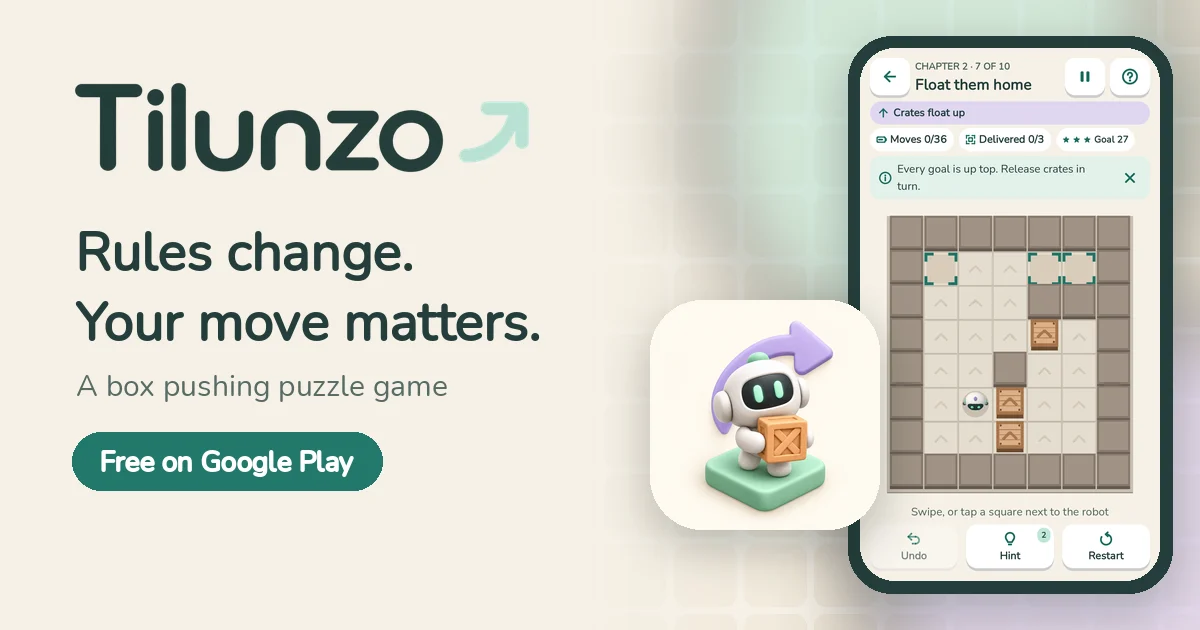
Tilunzo went from an empty repository on 3 October 2026 to a live Google Play game on 8 October, and to version 2.0.1 on a new engine by 20 October. Here is how we built it, what worked, and what we would do again.
The idea: Sokoban, but the rules change
Box-pushing puzzles are easy to learn: walk into a crate to push it, and get every crate onto a pad. We wanted each chapter to change one rule so the same skills feel new again: crates that float up after every move, a move limit, and a mirror robot that copies you with left and right flipped. The fifth chapter mixes all four in forty Expert puzzles.
Step 1: the rules engine came first
Before any graphics, we wrote the game rules as a plain C# library (.NET Standard 2.1) with no game-engine or ad code inside it. It loads levels in the standard XSB Sokoban text format, applies moves, handles Undo and replays, and ships with a command-line tool for checking levels.
Keeping the rules separate paid off twice: hundreds of automated tests (more than 550 by the Expert update) run in seconds without opening an engine, and the same core moved unchanged when we later switched engines.
Step 2: a solver that proves every puzzle
Every board in the game has a known minimum number of moves. A solver in the core searches for the optimal route, and the tests replay that route and the full Undo history for each shipped level, so a broken or unsolvable puzzle cannot reach players.
We also built a level generator. It samples rooms and crate placements, keeps only boards the real solver proves solvable, and ranks them by design signals such as crate switches on the best route, walking per push, dead-end states and "traps", where a hasty first push makes the puzzle impossible. For the floating-crate chapter it only keeps boards that cannot be solved without the new rule. A person still picks the final boards, so each puzzle has one clear idea and the difficulty curve keeps rising.
Step 3: the first version in Unity
Version 1 was a Unity app with Home, a puzzle grid per chapter, gameplay with a rule chip and move counter, Help, Settings, Pause and a result sheet. Progress and settings save only on the device. Every sound and the music are synthesized in code, so the game ships no audio files at all.
Between 8 and 14 October we shipped 1.0.2 to 1.0.8 on Google Play: Expert challenges and the delivery-robot look, Google Play Games achievements, large-screen fixes, ads and hints, Japanese, then Hindi and Arabic.
Step 4: eight languages, done properly
Tilunzo speaks English, Hindi, Spanish, Portuguese, German, French, Japanese and Arabic. Two languages needed real engineering. Hindi conjunct letters rendered wrongly in Unity's text system, so we built a reproducible Devanagari font generator and a coverage check. Arabic needed right-to-left text with the correct line order. Store listings and release notes were written for every language, within Google Play's 500-character limit.
Step 5: version 2.0 on Godot
For version 2.0 we rebuilt the app on Godot 4 with .NET, keeping the same tested C# core. Players' puzzles, stars and settings carried over automatically. The rebuild brought tablet layouts (a wider column, a 4 or 5 column puzzle grid and a two-pane landscape view), a loading screen and a smaller download thanks to R8 code shrinking.
Ads and privacy without surprises
Tilunzo is free and uses Google AdMob for a banner, ads between puzzles and optional rewarded ads for hints or extra moves. Firebase analytics waits for Google's consent check, and the game asks about reminders only after a player has solved three puzzles. The full privacy policy lives on tilunzo.com.
What we learned
- Write the rules as a tested library first; the engine on top can change.
- Let a solver check every level, and let a person choose which levels are fun.
- Plan languages early. Hindi and Arabic text rendering takes real work.
- Ship small updates often: we went from 1.0.2 to 2.0.1 in under two weeks after launch.
Tilunzo is free on Google Play. If you want a game, app or website built the same way, get in touch at akash@skywebhub.com.